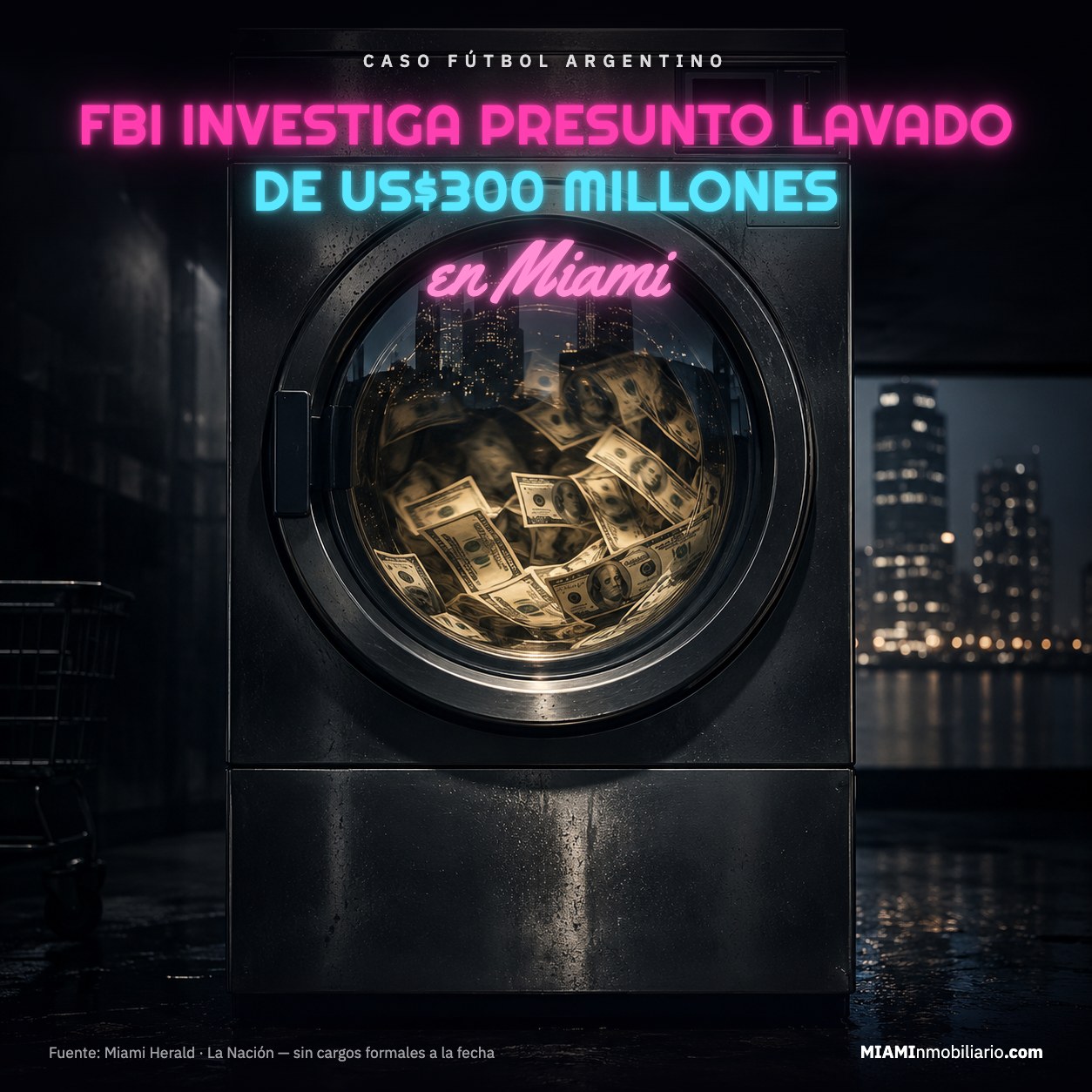
The same week Argentina plays the World Cup quarterfinals, the FBI is investigating whether more than $300 million from its soccer federation's sponsors ended up somewhere it should not have. And once again, the money trail runs through Miami: an LLC with an office in Aventura, Florida shell companies, and money-transfer businesses in the south of the state.
For anyone evaluating a property purchase in Miami from abroad, the news raises a reasonable question: how exposed is this market to dirty money, and what does that mean for a legitimate buyer?
The short answer: Miami has seen this movie for decades, but the regulatory landscape changed structurally in 2026. This note walks through the case, the history, and the new federal rule that is already operating at every closing table.
The case: Argentine soccer and an Aventura LLC
According to a report by the Argentine newspaper La Nación, confirmed by the Miami Herald, the FBI is investigating whether TourProdEnter LLC — a Florida entity formed in August 2021, with an office in Aventura — illegally channeled more than $300 million in sponsor payments from the Argentine Football Association through the US banking system and south Florida money-transfer businesses, ultimately reaching federation officials.
Sponsor payments, which historically went directly to the federation — and from there, largely, to youth clubs — began routing through Florida after the 2022 World Cup title, when the Aventura LLC became the exclusive international commercial agent. What investigators had already traced as of March, according to press accounts that reviewed the file:
- About $90 million in potentially irregular uses, a provisional figure expected to grow.
- $42 million moved through shell companies registered in Florida.
- At least $16.5 million in luxury spending.
- Details such as 17 transfers of $20,000 to the family of a "spiritual guide" who traveled with the team.
No formal charges have been filed to date in either the United States or Argentina. But the case has once again put Miami at the center of a network of opaque entities and cross-border transfers.
Miami has seen this movie before
The pattern is not new. Two precedents are enough to understand why Miami's federal prosecutors have so much practice at this:
FIFAgate (2015). Global soccer's biggest corruption scandal broke open with a raid on CONCACAF's headquarters in Miami Beach. The executive who pleaded guilty to negotiating more than $14 million in bribes for broadcast rights ran his sports-marketing firm out of Miami, according to the Department of Justice.
Operation Money Flight (2018). Miami federal prosecutors exposed a $1.2 billion scheme siphoned from Venezuela's state oil company, laundered in part through luxury condos in Sunny Isles Beach, according to the Department of Justice.
And going further back, a good part of Brickell's first tower boom in the 1980s was financed with capital fleeing Latin America without too many questions asked. The constant is always the same: money that moves fast, owners who stay invisible, and condos that function as a safe.
Why real estate attracts dirty money
The mechanics are simple to understand. A luxury property lets you park large sums in a single asset, holds its value, and for years could be bought in an LLC's name without disclosing who was behind it. If the purchase was also in cash — no bank involved — nobody in the financial system was asking the usual questions about the source of funds.
It is worth saying clearly: the vast majority of LLC purchases in Miami are perfectly legitimate. Buying through an entity is the standard structure for foreign buyers, for liability protection and estate planning, as we explain in the guide to buying Miami real estate with an LLC. The tool was never the problem; unchecked opacity was.
The landscape shifted: from geographic orders to a federal rule
The regulatory response has a ten-year history and a recent turning point:
- 2016. The US Treasury (FinCEN) launched the first geographic targeting orders (GTOs), requiring title companies to identify the real owners behind cash purchases made through entities. Miami was one of the first two markets in the country placed under scrutiny, and the orders were renewed and expanded for a decade.
- March 1, 2026. FinCEN's residential real estate rule took effect: permanent and nationwide. Every cash residential transfer to an LLC, partnership or trust must be reported, identifying the beneficial owner — the flesh-and-blood people behind the entity. The closing professional files the report, and the rule has no minimum dollar threshold.
Purchases with institutional financing fall outside the reporting requirement, because the bank already runs its own anti-money-laundering check when it originates the loan. Put differently: the era of buying towers without saying who you are is closing.
What it means for the legitimate buyer
For the foreign buyer with documented funds — the vast majority — the change translates into three concrete things:
- More paperwork at closing. If you buy in cash through an entity, the closing agent will ask you to identify the beneficial owners. It is a formality, not an obstacle: it helps to arrive with your corporate documentation in order.
- A cleaner market. Less competition, at the margin, from money that cannot explain its origin. That protects your asset's long-term value.
- No reason to abandon the LLC. The structure remains legal, standard and advisable in most cases, including for its tax treatment, as we cover in the note on property taxes for foreign owners.
For Miami, it is a test of maturity. The city that was built by taking in capital without asking questions now competes to take it in while asking questions. The Argentine soccer case will take years to resolve in the courts. Transparency, meanwhile, has already taken a seat at the closing table — and for the buyer with clean accounts, as we also cover in the note on buying in Miami as a foreigner, that is the best news in years.
Frequently asked questions
Is it still legal to buy a property in Miami with an LLC?
Yes. Buying through an LLC remains legal and is the standard structure for most foreign buyers. What changed is transparency: since March 1, 2026, if the purchase is in cash, the closing professional must report to FinCEN who the real people behind the entity are.
What is FinCEN's residential real estate rule?
It is a permanent federal rule, in effect since March 1, 2026, requiring the beneficial owner to be reported for every cash residential purchase made by an LLC, partnership or trust anywhere in the United States. It replaces and expands the temporary geographic orders that had covered Miami since 2016.
Is buying in cash suspicious?
No. Buying in cash is legal and common in Miami, especially among international buyers. The rule does not prohibit anything: it requires identifying the people behind the purchasing entity. A legitimate buyer with documented fund sources should just expect a bit more paperwork at closing.
Does the Argentine soccer case affect Miami's real estate market?
The direct effect on prices is nil: the investigation targets financial flows, not a segment of the market. The real effect is scrutiny: every case like this accelerates regulatory transparency, which over time professionalizes the market and protects the legitimate buyer.